Company [REDACTED]'s 1-Way Mirror Up Close
Interview and profile by Sophia Halimah Parker.
Photos by Joohee Park.
dance crush (n): someone who dances or makes dance that you admire, adore, fixate on, avoid, and/or obsess over in secret, out-loud, at a distance, and/or up close.
I first met Cole Stapleton, Mimi Doan, and Sacha Vega in the summer of 2023, by way of a dance-theater love square. Mimi and I were performing in a canon, a tightrope, a trust fall directed by Sacha, while Cole and I met working on Scottie Harvey’s A Live-Action Adaptation of an Episode of Tom & Jerry. Inspired by their curiosity and their commitment to queering dance, I was smitten. By August, I’d been invited to join Cole and Mimi’s ensemble of unfettered movers, Company [REDACTED], to work on their ambitious piece My Apocalypse, and the following year Sacha enlisted me to do dramaturgy for her show PINCH. In short, they are my most unwavering, my most enduring dance crushes.
As I thought about how to write about Company [REDACTED]’s new show 1-Way Mirror, I knew it would be impossible to maintain the distance that impartiality requires. I missed the closeness I felt while working with them; it seemed impossible to separate from any account of their work. So, about halfway through Company [REDACTED]’s residency leading up to the premiere of 1-Way Mirror, I sat on a rehearsal:
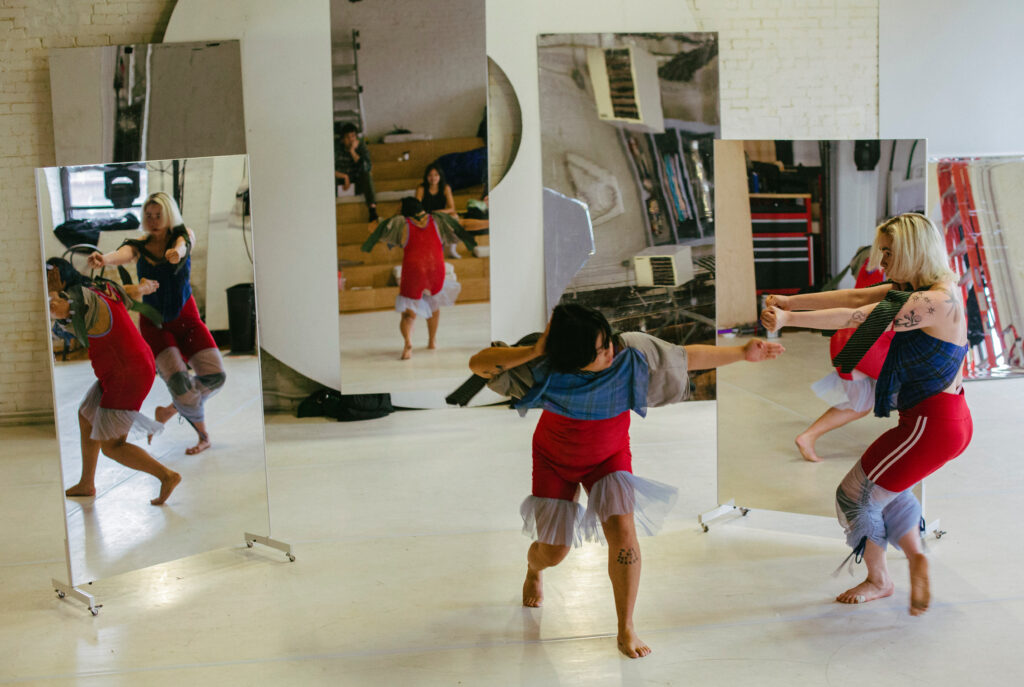
When I walk into 3am Theater, Cole and Mimi are trying on what looks like cotton underwear you might put on a doll–billowing, oversized bloomers with puffed sleeves that are as modest as they are absurd–provocative but not sexy. Sacha looks on, resting her chin in the palm of her hands, lobbing question after question to Cole and Mimi about the fit and movement of the garments. What feels possible and what is actually possible? Small bits of choreography spill out of Cole and Mimi’s bodies–teasing the larger gestures and movement phrases to come. And then there it is—the familiar heat of Cole and Mimi’s inquiry—the heat of jealousy I humbly manage, seeing two collaborators, partners, lovers, negotiate detail after detail with casual rigour. They prepare for a full run-through of the show: warming up, rehearsing beats, finding the nooks where armpits and ankles should interlock.
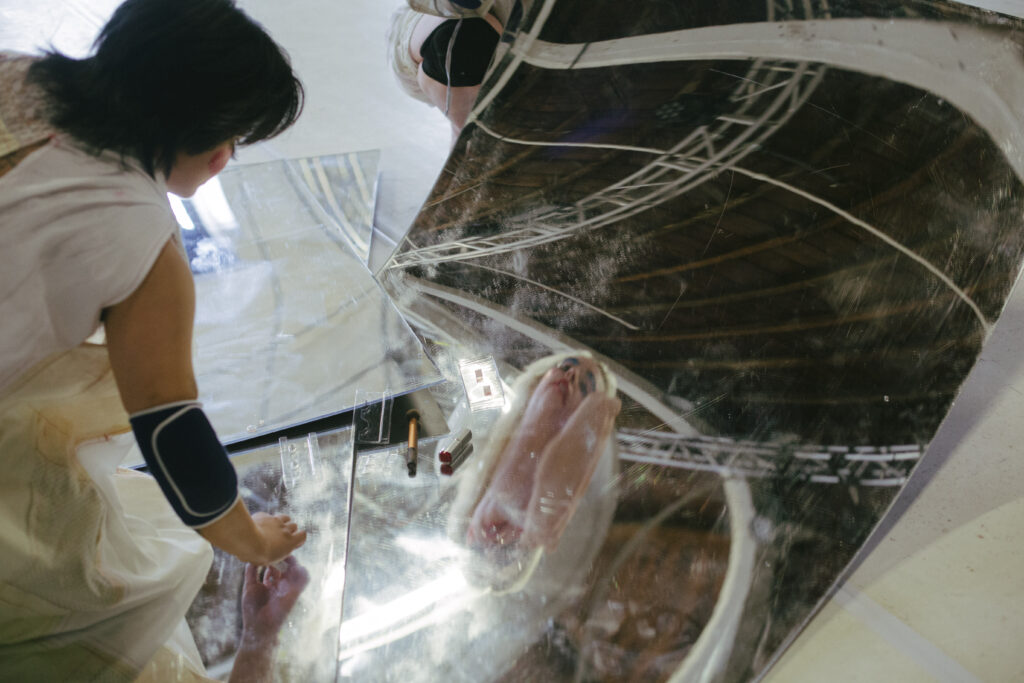
I take in the rehearsal pace, finding myself in the mirrors mounted around the studio. I am suddenly conscious of all the ways I’ve been avoiding self-reflection lately: less writing, more drinking, less contemplation of my own life and more contemplation of Jojo Siwa’s. As they begin the run, it occurs to me that this avoidance of my own gaze–the fear of finding something in the mirror not reflective of who I am–is in many ways what 1-Way Mirror is about.
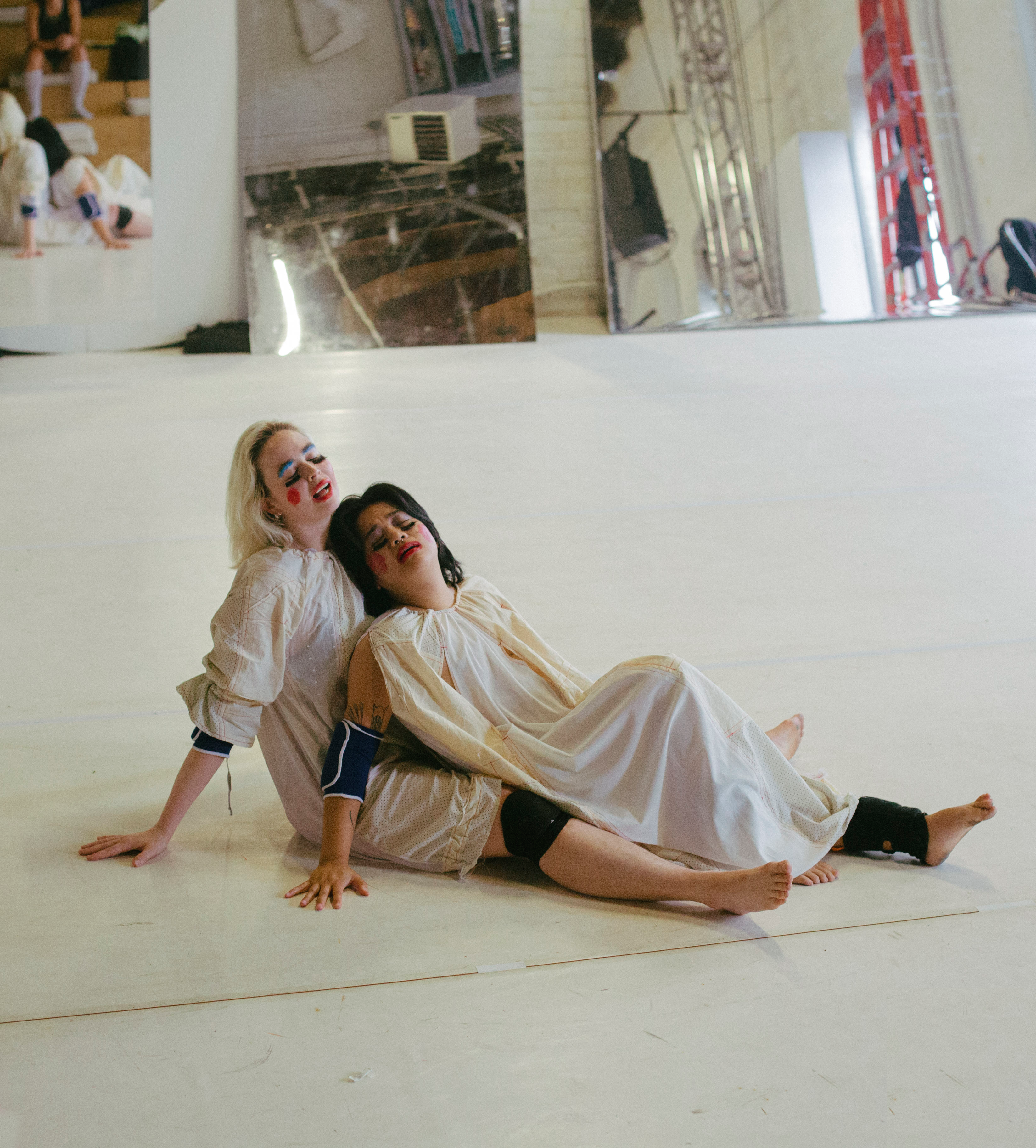 I write down encounter, discovery, transformation to label the three distinct sections and their characters that make up the show. In encounter we meet Baby and Mommy–shaky and sturdy respectively. As Baby, Cole latches themself to Mommy’s (Mimi’s) side while Mommy walks in dainty yet labored steps across the stage. Later, Mommy and Baby launch into a joint monologue sampled from an episode of TLC’s sMothered. Mimi and Cole’s vacant delivery of the text is expertly timed; as they describe the benefits of taking baths in green juice together I bite my lip, holding back the sort of grin that only emerges from guilty pleasure. Discovery is where we meet young Nikki and Michael, who flaunt fantasy and savor the changes of their pubescent bodies. I ask myself if I’m more of a Nikki–someone who gets distracted by their ass in the mirror and shakes it with unabashed discipline. Or am I more of a Michael? Left alone to flex my muscles and stroke my nipples, perhaps I become the very fish I’m trying to catch. Then transformation, as Cole and Mimi become Cole and Mimi. This final section begins with a recording of the two dancers-slash-lovers recounting how they first met at a party and tried to gauge one another’s flirtatious signalling. The show ends with them laying on the ground, propped on their elbows as they mirror each other’s movements–each seeing themselves lovingly, truly reflected in the other.
Watch my interview with Company [REDACTED] by clicking the player below, or scroll on to read the full transcript:
I take in the rehearsal pace, finding myself in the mirrors mounted around the studio. I am suddenly conscious of all the ways I’ve been avoiding self-reflection lately: less writing, more drinking, less contemplation of my own life and more contemplation of Jojo Siwa’s. As they begin the run, it occurs to me that this avoidance of my own gaze–the fear of finding something in the mirror not reflective of who I am–is in many ways what 1-Way Mirror is about.
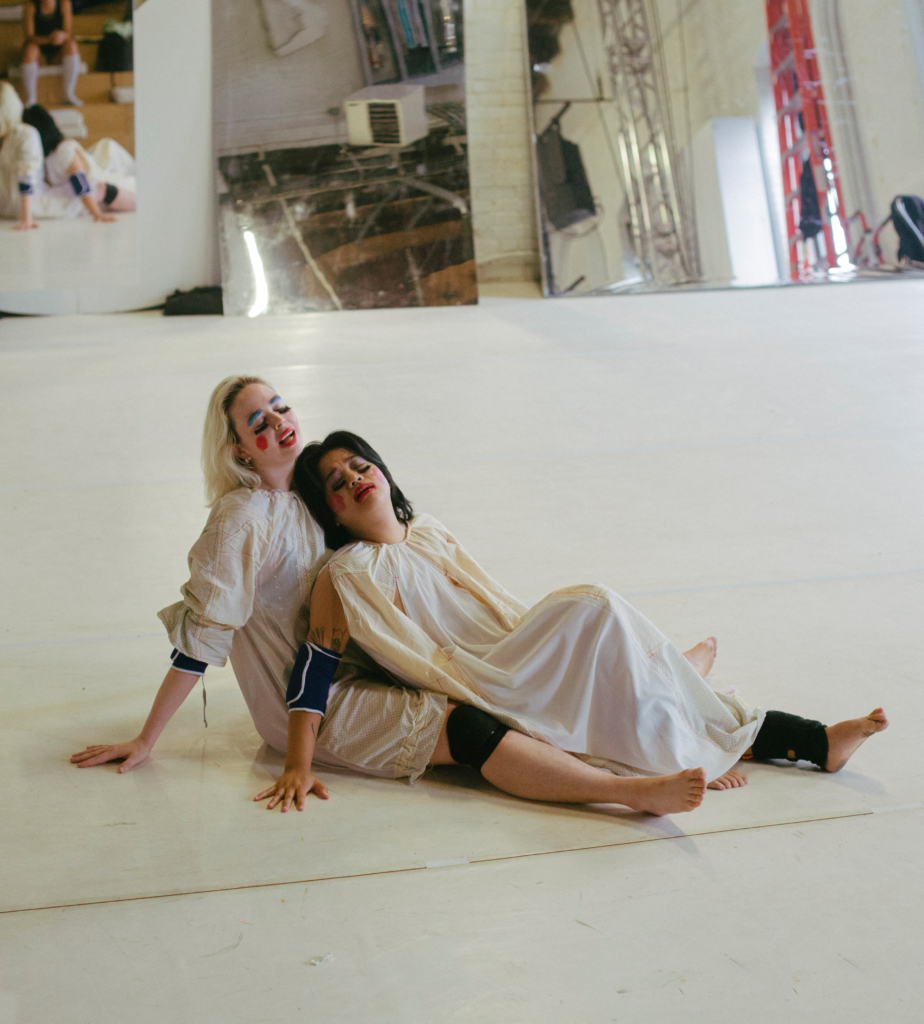
I write down encounter, discovery, transformation to label the three distinct sections and their characters that make up the show. In encounter we meet Baby and Mommy–shaky and sturdy respectively. As Baby, Cole latches themself to Mommy’s (Mimi’s) side while Mommy walks in dainty yet labored steps across the stage. Later, Mommy and Baby launch into a joint monologue sampled from an episode of TLC’s sMothered. Mimi and Cole’s vacant delivery of the text is expertly timed; as they describe the benefits of taking baths in green juice together I bite my lip, holding back the sort of grin that only emerges from guilty pleasure. Discovery is where we meet young Nikki and Michael, who flaunt fantasy and savor the changes of their pubescent bodies. I ask myself if I’m more of a Nikki–someone who gets distracted by their ass in the mirror and shakes it with unabashed discipline. Or am I more of a Michael? Left alone to flex my muscles and stroke my nipples, perhaps I become the very fish I’m trying to catch. Then transformation, as Cole and Mimi become Cole and Mimi. This final section begins with a recording of the two dancers-slash-lovers recounting how they first met at a party and tried to gauge one another’s flirtatious signalling. The show ends with them laying on the ground, propped on their elbows as they mirror each other’s movements–each seeing themselves lovingly, truly reflected in the other.
Watch my interview with Company [REDACTED] by clicking the player below, or scroll on to read the full transcript:
Note: At the time of publishing, It’s been over a month since 1-Way Mirror’s premiere at 3am and I need to see it again. Cole, Mimi, and Sacha are taking it to Cannonball Fest in Philly in September. I know the work will only deepen. Whoever goes will be lucky to indulge in its saturation, transformation, and spillage of self.
TRANSCRIPT:
Sophia: Hi, I’m Sophia. I’m super excited to be here with Cole and Mimi from the choreographic duo [REDACTED] to talk about their new work that will premiere at 3AM Theater on June 6th. Thank you so much for having me in rehearsal. I love a rehearsal room.
I wanna maybe just start with how was that run just now? You’re halfway through this one week residency, right?
Mimi: Yeah, exactly at the halfway point. Yeah.
Cole: How was that for you?
Mimi: How was that for you?
Cole: It felt good. I really love this room of people that was here today. I think actually running and rehearsing in front of artists that you love and respect is a little scarier than running in front of a general audience of people that have come to a show. It didn’t feel scary–but you really want to do a good job. Especially because we’re still at the phase where we’re not running with lights, or the technical aspects that we’ll have of the show. You really want the concept to feel like it’s coming across, and I felt like we did that today. I feel really good about it.
Mimi: For sure. I feel so fully immersed in the fantasy of it when I’m performing it now. Which is definitely not how I was feeling at the beginning of the week. I think throughout this process, it’s at times been difficult to get into the different characters of the different doppelganger pairings that we’ve created for this show. Just because the landscape of memory can feel really treacherous at times. And of course we have this resistance to re-invoking the pain of that. But I think that’s part of the reason we’re doing this show. Like the only way out is through.
Sophia: Can you tell me a little bit more? What is this fantasy for these characters?
Mimi: We play three different doppelganger pairings. The first is Mommy and Baby. I’m Mommy–Cole’s Baby. The second, we play these childhood–like these versions of our idealized childhood selves–Nikki and Michael. And the last pairing is Mimi and Cole, the auto fictitious version of Mimi and Cole.
Cole: I think that in general, we’re sort of exploring all the different ways that a doppelganger can exist outside of a true identical pairing. What does it mean to be raised to be the same as something?
We were also trying to explore how [Mimi & I] feel like doppelgangers, even though we don’t have that visual effect out in the world. People don’t think we’re sisters–like many lesbians are mistaken for. But I think there’s a real internal sense of being very locked in. So we were fantasizing with how to extrapolate that outwards: playing with visual doppelgangers, and visual similarities, and also character similarity.
Sophia: Right. That totally comes through with the mirror–the physical mirrors in space–but also how you mirror each other, and how there’s always that feeling that you’re locked in with someone. But there’s always going to be something a little off in connection.
In this run, I was thinking about encounter. And what is that? And what is seeing yourself in somebody else, really? Why? Is it selfish? Is it indulgent? I was thinking about that a lot. I kinda wanted to talk about coming of age to your ideal self. It has this tone… that swelled precipice of being kind of who you want, but not really. Could you talk to me a little about that?
Cole: The central question for the show that we had going into the process was, Are you still your mother’s daughter if you’re no longer a woman? We were really grappling with this role of daughterhood in both of our lives. As both of us have navigated transition in different ways, the role of being a daughter felt like the hardest thing to shed.
And it’s a very gendered role, but it also sort of predates your existence–your understanding of your own gender, if you were raised as someone’s daughter. So that was sort of our central question.
We were really inspired by Naomi Klein’s book Doppelganger. And as we were thinking about that work, and the political implications of doppelgangers and what it means to be on a similar trajectory as someone else, and then split and divide ways…
We were thinking about mother/daughter pairings as doppelganger relationships. When you’re raised as someone’s daughter, our stance in this work–and it’s not a universal truth–but our take on it was that you’re raised as your mother’s doppelganger. And when you diverge from that path–which for us, was by way of transition–what happens to the likeness? And the sameness, and the shared experience, and all of the ground of familiarity and similarity? Does that just go away? What do you do with that? For people raised as women, it’s sort of like your first inheritance.
So that became this fractured tree of doppelgangers, where we were like: We want to set up a mother/daughter doppelganger pairing. We also want to really put ourselves in the work and explore how we are doppelgangers and also not doppelgangers. And then when it came to our childhoods, it really felt like we were wanting to look back through the lens of fantasy. Not necessarily recreating our own gendered experiences, but actually recreating what we maybe wish we got to experience. We wanted to give these characters a threshold of freedom that doesn’t really exist in the real world to express their gendered fantasies.
For me, exploring my background, I was thinking a lot about my strict classical ballet training. When I was thinking about my own doppelganger split-off, I was really thinking about when I started to transition, or started to come into my gender, I also moved away from my ballet background and my training. But there was a period of my life–before all the training trauma–that ballet was really joyful. It was really pleasurable and it was full of fantasy. So that was like the sort of space for me that I was really exploring with the Nikki character.
What was it like for the Michael character?
Mimi: Yeah, Michael is really rooted in the version of boyhood that I felt like I never experienced, but witnessed from afar. Within this section, I’m trying on all of these layers of masculinity.
Some of the memories that I’m trying to revisit are from growing up being raised in a very Vietnamese Catholic household. Before my dad met my mom, he was in seminary–he was going to be a priest. For my entire childhood, every Sunday I would go to Sunday school and get that religious education and then take Vietnamese classes and then go to church with my entire class of peers.
Then afterwards, like a lot of the boys would go behind the church, and they would do their break dancing thing. I would always watch that from afar, because all the girls had to wear skirts. So at the end of this really stifling and regimented schedule, I would watch all these boys have this moment of release and freedom and have this feeling of jealousy. It was jealousy, but not quite–because I had this narrative at the time that I could never have what they had together.
This section feels like it’s bathing in all of these feelings of desire and fantasy. Being able to find a partner in play that felt equal, but who was someone that I felt like I could challenge. I think these are core feelings in this middle section.
Sophia: I wrote something down about trying to catch the fish and immediately becoming the fish. Which was this really great sort of physical metaphor. I’m the guy who can go out on the dock… then immediately becoming the thing that’s floppy and gasping for air.
Another thing I wanted to talk about is process. I’ve been in your work before, so being inside from that way–I feel so close to you in this room. It was really strange, but special and amazing.
I want you to talk more about how this is different–how duetting, being directed by Sacha is different from other processes you’ve done together.
Mimi: Totally. Cole and I have been collaborating for almost six years at this point, and this is the first time that we’ve made a non-ensemble piece that’s just the two of us as choreographers and performers. Sacha has said in the past that this feels like we’re putting a stake in the sand and saying, This is who we are, and this is the kind of work we want to make.
In a big way it feels like a coming of age as choreographers as well. It’s definitely the most vulnerable work we’ve ever made. We’re putting ourselves on display in a way that we’ve never done before.
Cole: We sort of fell into making work together. We never intended to have a choreographic collaboration. It happened very organically. I think it followed quite naturally to make our first pieces with ensembles because we didn’t know what we were doing, so we got to borrow so much. We had such skilled, incredible artists that were so generous in working with us. We just got to learn so much. And in a very real way, the movement and the choreography and the actual content of the work was generated by the people in the room. We got to string that together, but we always had the incredible benefit of working with amazing movement generators that were responding to our ideas and responding to the prompts and what was in the room and characters and stories–really generating a lot of the movement, and all we had to do was thread that needle and shape it.
In this process, we knew that if we were going to be the performers, we needed an outside eye to help shape this. Also in My Apocalypse the piece that you [Sophia] were in–that was a piece of feedback that we got from the performers. We were both in the show and making it, so there was a real desire to have a director who was in charge of creating the image. We took that feedback to heart and wanted to set ourselves up for success in this very different and vulnerable endeavor of making a piece that’s just us.
Sacha has been such a gift. You’ve also been in Sacha’s work, so you know what an incredibly honed and skilled artist she is. Like we said earlier, we were punching up in asking her to do this with us, and we feel really lucky she said yes. You guys both got to be in a work of hers, and her most recent work PINCH had Avery, who was also in My Apocalypse. So there’s a lot of crossover. Whoever is making a piece inevitably leaves a thumbprint of themselves on that work, and we were really eager to have Sacha’s thumbprint on this work. I’m really excited about the ways in which I see her aesthetics and her tastes and her sense of humor having contributed to the way that the work has grown. We feel so lucky.
And when we’ve spoken about it in the past, when we’ve brought up this configuration in different peer groups that we’re in with other choreographers, people were quite confused that we were the choreographers but we’d asked someone else to direct. We got a question mark face about that–but to us it made so much sense.
Sophia: There needs to be more of that, in my opinion. I think you’re totally spot on. Sacha has a great understanding of timing and humor for material that’s dealing with memory, with something a bit heavier… For that you need someone with a keen sense of balance, and absurdity-pushing moments.
I really felt so satisfied in this run. I know you’re like oh the tech, and all these other layers still have to fall in. But for the bones of it, it’s really nuanced and cohesive and satisfying… It’s strange!
Cole: It’s definitely the weirdest piece that we’ve made. And we’ve made very weird work before, but this really takes it to another level of absurd. We were trying to push these characters to the very edge.
Also realizing: We thought that we were performers who took risks. But truly, I don’t think either of us were acquainted with risk before this piece. Taking risk as a performer–and as an author of a piece, how much of yourself you’re putting into it… This is risk on another level for us.
Sophia: Well you’re going there. I’m serious–I really feel it in this way that’s–I don’t want to say challenging–but as an audience member I felt confronted. I was thinking a lot about encounter and discovery. Those moments I caught myself in the mirror. That feels like you’re recreating a moment that you’re having with each other and with yourself for the audience.
I’m really excited for both of you. I’m excited for One-Way Mirror at 3AM Theater Next Friday. Psyched to write about this for Gryllus.world, and to have a little beautiful record of your work, and your work with Sacha. Love ya!
Mimi & Cole: Love ya!