Sex & Suicide with Edmund White
Edmund White discusses The Humble Lover, Heian Japan, and how to write a great sex scene.
by Dylan Cloud
To many, Edmund White is a kind of saint of gay literature. To encounter his work is to discover a shocking talent, and a stark power to reimagine a literary canon steeped in tradition and claim his place within it. White’s prose is precise but sumptuous. Between richly-observed, often musical passages of Proustian sensuality, he makes devastatingly shrewd psychological insights. His eye for character is perhaps as sharp as the 19th-century French Realists he deeply admires. He lingers on the lewd, the smutty, instilling the sexuality which is ubiquitous in his books with rare power; for White, sex is an act of discovery, of memory, of rebellion, of consumption, of fun… More than just documenting life as a gay writer in 20th-century America, White’s work helped to establish gayness as a literary subject that could be openly explored.
White’s influence on queer literature is hard to overstate. His most widely-read book is A Boy’s Own Story, a semi-autobiographical bildungsroman set in the 1950s Midwest–the first part of a trilogy which also includes The Beautiful Room is Empty and The Farewell Symphony. White’s debut novel Forgetting Elena was loved by Vladmir Nabokov, and his second novel, Nocturne for the King of Naples is beloved by many of his readers today for its esoteric and moody lyricism. His memoirs City Boy, My Lives, and Our Paris are as replete with charm as they are stories of White’s friendships with literary figures such as Susan Sontag, John Ashbery, and Michel Foucault. In 1977, White and his former psychiatrist co-wrote The Joy of Gay Sex, a best-selling ‘how-to guide’ for sex between gay men, and in the eighties White helped found the Gay Men’s Health Crisis. In 1993, he published an 800-page biography of the French writer Jean Genet. His latest book is The Humble Lover, which follows a kind of romance between a young ballet dancer and his geriatric patron.
In March of 2024, Gryllus editor Dylan Cloud sat down with White for an interview at his home in Chelsea.
Gryllus: Where did the idea for The Humble Lover begin?
EW: The idea of a no sex, chaste marriage where you sleep in the same bed but don’t have sex, that actually occurred to me–I think I mentioned it in My Lives or City Boy. I was in love with [the actor] Keith McDermott, and we would sleep in the same bed but not have sex.
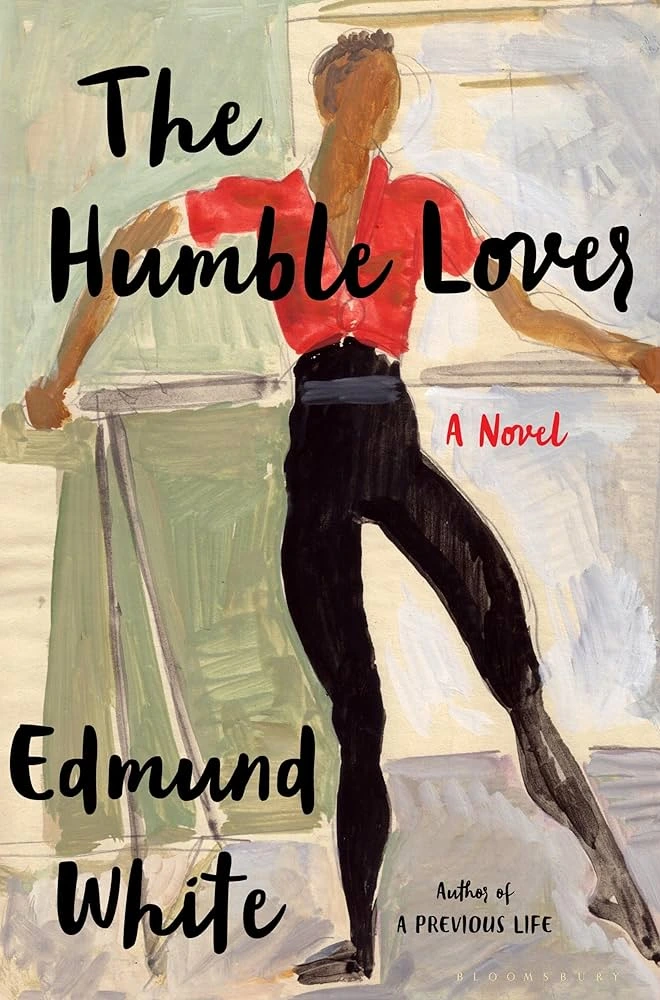
I’m a huge ballet fan and have been since the 60s when I moved to New York. I used to sit up in the peanut gallery for 98 cents and count out my pennies on the floor to make sure I had enough. I dated a couple of ballet dancers, and there was always a world there that I was fascinated by.
My best friend was David Kalstone, and he was a ballet fan, and so was my agent, Maxine Groski. We would go to the ballet all the time–it was our dream. Actually, Maxine and David became friends with several of the ballet dancers. I never did, except with those two boys I went out with.
Gryllus: Your latest run of novels from the past few years have been incredibly funny and touching, and are among the strongest of your career. To what do you attribute this burst of creative energy?
EW: Well, retirement. That’s part of it. And tremendous help from Michael [Carroll, White’s husband] in running our lives. He frees me up–but he’s also very good at advising. We do a thing called plot walking, which is where you figure out what’s going to happen next. He’s published two books of his own.
Those last four novels haven’t gotten very good reviews–especially not in England. One review of A Previous Life said, ‘oh it’s sad–he began so well and he ended so dismally.’
Gryllus: I thought that was such a wonderful book. One of my favorites of yours. I’m surprised to hear that.
EW: Well, I don’t know… people. Maybe there was TMI–too much information. I don’t know. One of my most faithful readers said this is revenge porn.
Gryllus: What made you want to write yourself into A Previous Life?
EW: You know, it was about my affair with that Italian. And in the early part, he and I were still going together. He helped me with all that stuff about Sicily and his early affairs with women and men. He was very helpful and forthcoming. And then we broke up and I never heard from him again.
I guess I put myself in partly because I thought: if I bad-mouth myself, nobody else can do it.
Gryllus: And some of his actual emails were included in A Previous Life, is that right?
EW: Yeah, all of the emails were actually his.
Gryllus: I love that switch at the end, how the structure changes up. Ruggero and Constance are going back and forth and then it gets to this almost epistolary thing. It’s great.
EW: Oh, thank you. My great nephew and his wife–they actually had dinner with Giuseppe, and they all liked each other very much. They’re polyamorous. I think it was quite a seductive dinner. I thought that would be a nice way to end it.
Gryllus: It’s fantastic. You die, and then you kind of come back as your own great nephew.
EW: One of my novels–Our Young Man–was based on Daudet’s Sappho. It’s a 19th century French novel, and it’s called Sappho, but it’s not about lesbianism. It’s about a kept woman who’s 40 but looks 20, and she decides she’s had enough with all of these men keeping her. She wants a young lover of her own. So, she meets a kind of ruined aristocrat who’s 20, and he thinks she’s the same age as he is. And later he discovers that every rich man in town has had her, but he’s still so much in love with her that he can’t break from her. And then she finally leaves him. But anyway, that’s the plot of Daudet’s book. And I can’t say I followed it exactly, but it inspired me.
Gryllus: What attracts you to these aristocratic, really wealthy characters?
EW: Isn’t that terrible? I mean, I guess the same reason Henry James liked it. Rich people can have a lot of freedom. They can do whatever they want. And poor people are so imprisoned by the circumstances of their life.
At this point in the interview, White’s husband Michael Carroll, who’s been doing dishes in the background, comes over. Carroll is a writer who has published several books, and in 2023 collaborated with painter Brian Alessandro to adapt A Boy’s Own Story into a graphic novel.
Michael Carroll: I want to say before I go–when I was working on the graphic novel with Brian [Alessandro], who’s kind of a basic bitch, but I love him, he’s like my brother.
We’re trying to turn it into a limited series for TV, and we were creating the show bible, doing all these different versions. So we’re working together one day at his house in New Jersey, and Brian says ‘And then Eddie moves to Paris, and he goes to all the finest restaurants and wears all the finest clothes.’ And I thought, you really don’t have it at all. Ed was there to continue being a writer. All he ever wanted to be was a writer. Not famous and rich–just a really good writer. People sort of don’t understand that.
But he learned from the French. And one time, he called Christopher Isherwood–long before I was on the scene–and was reading part of a French novel to him. And Isherwood was not a pro-French novel kind of guy…
EW: [Isherwood] started laughing. I thought I was reading a very sad passage from Chateaubriand’s Memoirs where he talked about descending the steps of the tomb as he died. And I said, isn’t this touching? And Isherwood roared with laughter because he was pro German, anti-French.
Gryllus: What was your friendship with Isherwood like?
EW: It was close. And with Don [Bachardy]. I wrote the introduction to Don’s book of drawings of Isherwood dying and dead. I also wrote the introduction to some of Isherwood’s diaries. Our friend Kate Bucknell has written a new biography which is sensational–in my blurb I said, this is the best biography I’ve ever read.
I met him in New York, through the composer Virgil Thompson. He had me and my lover at the time, who was Virgil’s assistant, and Don and Chris all to dinner. And then I had them to dinner the next night because we all liked each other so much.
Then I broke up with that guy and fell for a painter out on the west coast. I was trying to seduce him, so I thought, oh, we’ll spend time with Chris and Don and maybe he’ll get the idea. He didn’t.
Gryllus: You’ve expressed that you struggle with plotting, and have previously described your early novels having an almost scrapbook quality. But as time has gone on, your books have gotten more plot driven. How has your approach changed?
EW: I was a very good friend of Michel Foucault. In fact, there’s a portrait of us in the hallway. You must look at that.
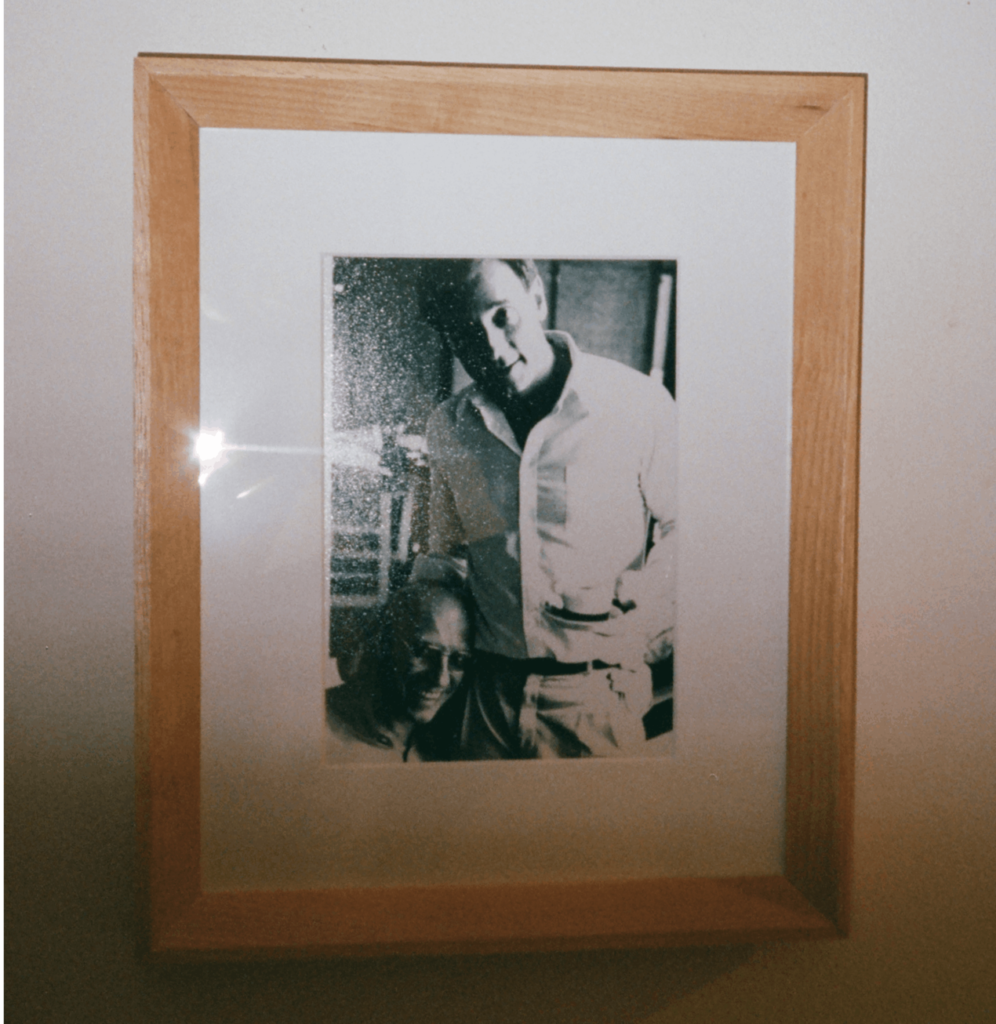
Anyway, he always said: well, people wonder why the last volumes of the History of Sexuality are so much clearer than the early books I wrote.’ And he said it’s because he learned how to write. Of course the French would complain that they were too clear.
I always admired plot driven books, but didn’t quite know how to do them. And of course, my first book Forgetting Elena is kind of [plot driven].
Gryllus: Definitely. And you’ve mentioned in places about how some of that comes from your experience teaching.
EW: Yes, well, you read a young person’s story and it starts with him looking at himself in the mirror for half an hour and then it talks about his parents and how wonderful they are or how terrible, and if they’re Catholic they talk about the nuns, how horrible they were.
Gryllus: Many of your books are structured around complex and compassionate portraits of characters, often based on real people, from whom the narrative almost emanates. What qualities do you look for in a person that makes you want to include them in one of your books?
EW: Sometimes I think they’ll have a paradox within. For instance, I’m writing a book now called Hospitality. I had a friend who was a writer, Gabe Hudson, and he was 6’3, a marine, heterosexual–everyone adored him. He’d won all these prizes for his first book, Dear Mr. President, which was kind of a fantasy of letters written from somebody in the Iraq war to the president. He had great success, and then a ten year dry spell, and couldn’t write anything. And after that he wrote a dragon book for children. Every day he would write, whatever that meant. If all you can do after ten years is write a dragon book… I don’t know.
Anyway, then he committed suicide. So I thought, he’s like the man who had everything and then hated himself and hated his life, and then he took a strong exit. So that’s one character who interests me.
In Forgetting Elena, for instance, there’s a character called Herbert who was based on a Swedish guy that we were all kind of fascinated by called Kaj–and he committed suicide. Seems like everybody commits suicide… But we were in our 20s and Kaj was three or four years older than us, which seemed vastly older. Again, the person who had everything–he was absolutely solar in his beauty and he was rich. But life didn’t suit him.
Gryllus: And this is the guy in Forgetting Elena who has the cult of personality surrounding him. I was wondering, where did that spontaneous poetry device in Forgetting Elena come from?
EW: From Heian, Japan–which is the time when The Tale of Genji was written. In the Genji the ladies are always going out to look at the cherry blossoms, and the emperor sends a poem. They’re supposed to write back right away–poems that use some of the same words and some of the same images that will flatter the emperor’s poem, and attach it to a branch of cherry blossoms.
But there’s a famous moment–I guess it’s either in Genji or in The Pillow Book by Sei Shōnagon–when they can’t think of any poems. They’re so disgraced because the emperor sent his poem and none of them has the wit to answer.
I think sex in that period in the court seems at once very refined and very barbaric. Women were never seen. They were always behind their screens of state. Sei Shōnagon says she had never seen a naked body until a woman went mad in the courtyard and tore off all her clothes. And Sei Shōnagon said–Oh, she looked like a worm, like a white worm.
And if you look at Japanese pornography, let’s say of the Ukiyo-e period, they’re always wearing lots of clothes. The men had these enormous penises and the women had these big hairy clams. But they’re all clothed and robed. The women would be behind their screens at state, and the men would prowl around the palace–the warriors, the samurai–and they would suddenly come in and fuck a woman, but without any light, and they wouldn’t see who they were.
And then they would write them a morning-after poem, which was obligatory, and the woman then had to write back her own poem. As though she really had loved the rape. And uh, anyway, that was, I guess, where I got that from.
Gryllus: In A Boy’s Own Story and other of your books, you describe practicing Buddhism when you were young.
EW: Yes, I studied Buddhist art in college. And one of my best friends is Yiyun Li. Both of her sons committed suicide in their teenage years. And they both did it the same way–threw themselves in front of a train. They were both big admirers of Anna Karenina.
I’m always trying to stay in touch with her every day without suggesting that she has to do anything or call me. But she does respond. I spoke to her on the phone yesterday. I sent her a little Buddha for the garden–well, these are called mudras, the hand gestures–and this one means Abhaya, don’t fear–so I sent her one of those.
But I was a kind of Buddhist, I guess, from like the age of 12 to 16 or something.
Gryllus: As you write about in a several places, notably in the final chapter of The Beautiful Room is Empty, you were at Stonewall when the first riot broke out. I love your descriptions there, and in “The Political Vocabulary of Homosexuality,” of the crowd laughing at the political slogans being shouted out.
EW: Gay is good–which seemed funny to us, because we thought we were a neurosis rather than a minority.
Gryllus: Why do you think that laughter was important to document?
EW: I think because–like I’ve said several times–it was the first funny revolution. I think it was funny because it was code switching–if you think that you’re a neurotic and you suddenly say gay is good… Nobody, not even Proust, before Stonewall could say gay is good.
I mean, I suppose Magnus Hirschfeld could. But in my experience, until Stonewall, there was always a certain point in the evening when we’d all sigh and say, Oh, gosh, we’re so sick. That was the idea–that we were sick. And we were all in therapy to go straight.
Gryllus: You often write about your therapist.
EW: Yeah, right.
Gryllus: And he ended up killing himself, as well.
EW: Yeah.
Gryllus: Throughout your career you’ve wrestled with the categorization of ‘the gay writer.’ How has this conception changed over the years, and where do you see gay literature going?
EW: I guess I always thought I was a gay writer. When I moved to Paris in ‘82 or ‘83, a gay magazine there called Masques asked me, Are you a gay writer? I said yes. And they said you’re the first person we’ve ever interviewed who said yes to that. And I said, well, you know it is kind of my niche market.
People have often said to me, don’t you wish you had a wider readership? And I said, in these days, to have a readership at all–it’s a great thing. Even if it’s just a few old men in DC or something.
Although I have written books that aren’t gay. Like Fanny and Caracole. I was always fascinated by 18th century dandies, who seemed so gay to us and yet were heterosexual. So I thought I could explore that in Caracole.
I don’t know. It has been a very rich subject matter for me.
Gryllus: What’s the secret to writing a great sex scene?
EW: Well, like in Forgetting Elena–I guess in a way it’s like that Russian formalist idea of ‘make it strange.’ Like in Tolstoy, a girl goes to her first opera, and she just thinks everybody’s screaming and the audience are beating their hands together. It’s described as though you’re from Mars looking at the thing. Or the first ball of a girl in War and Peace. It’s always that kind of alienation effect. For instance, in Forgetting Elena, he doesn’t know what sex is, and he thinks it might be as painful as it is pleasurable.
I mean, obviously there are other aspects to a good sex scene. I always say that my sex scenes might cost somebody some cum, but I don’t really think of them as pornographic. Sontag wrote an essay where she said that real pornography has got to be one-handed reading. It has to go to the rhythm of an actual orgasm. It has to not use original images, but be very basic about what turns people on, and basically it’s cliches that turn people on.
I feel like in my books, first of all the sex scenes advance the plot–I hope. And second of all, they are often comic. Comedy according to Henry Bergson occurs when the body fails the spirit. I mean, my characters don’t usually have good sex. It’s all sort of a disaster.
Gryllus: You’ve said that you read Henry Green’s novel Nothing every year. What do you love about that novel?
EW: It is so indirect and so sly. The idea of these spoiled rich parents, who were once in love and now each widowed, and they want to get together. But they kind of do it through these emissaries who are their children. And the mistress who is finally rejected. I don’t know, the whole angling between the mother and the father as they find their way back to each other, I think is terribly funny. Also the way that the children are impoverished and always going to these dreary pubs and having to work, while the parents are riding around in their Daimlers. I just think that’s so funny.
Gryllus: Who are some other writers you consider to be influences?
EW: Proust. Well, Isherwood and Proust–and Nabokov. All that sounds pretty grandiose to claim. I guess from the very beginning I wanted to write gay fiction–if it was going to be gay–that had some literary merit. I wanted to be a serious writer.
My fellow members of Violet Quill–Felice Picano, I’m sure, has sold many, many more copies than I ever have. He thinks of himself as the leader of our group, I saw that in print yesterday. Maybe he’ll make room for Andrew Holleran.
Gryllus: I wanted to ask about Violet Quill and Andrew Holleran. I know some of our readers love Dancer from the Dance.
EW: Well, Violet Quill only met about eight times. And it was mainly about desserts. I mean, we would prepare these gorgeous desserts for each other.
I think, in a way, it was kind of staking out territory. It became clear that Andrew Holleran would write mainly about Fire Island, and I would write mainly about childhood. Without even discussing it–since we would read to each other, we would see what the other one used as a territory.
Robert Ferro would write about the family’–and gays were insisting that this big Italian-American family accept the lover and enshrine his picture with the grandsons up on the photomontage of all the descendants and all their lovers. That’s sort of the key to Second Son, I think.
So each of us would stake out some territory. One of us [George Whitmore] wrote about being in sex therapy, it was called The Confession of Danny Slocum. We wrote about all different things.
Gryllus: What’s something you’ve read in the past year that you loved?
EW: Neel Mukherjee has a book called Choice. That was great. As I said, I loved the biography that Kate Bucknell wrote of Isherwood. And there’s an English writer called Tom Crewe, who wrote The New Life. It was sort of about Havelock Ellis and people who were exploring sexualities in the 1880s, 90s. I loved that.
I always loved Kawabata and Tanizaki. I reread them often. I used to teach Kawabata’s The Sound of the Mountain, so I would read it every year. I do think that’s a masterpiece.
Gryllus: Are you working on anything new?
EW: Yes, this book called Hospitality. And I also finished another novel. And I finished a sex memoir. The sex memoir, which is called The Loves of my Life, is what they want to publish next, but not until January.
Bloomsbury is so slow–and then they want to wait another year to bring out the novel which is already finished. That’s called The Spirit Lamp, and it’s about my nephew’s suicide. Always suicides, my god.
I’ve done this thing of adapting French fiction, or being inspired by it. The Spirit Lamp is inspired by Gauthier’s Spirite, and it follows the Gauthier plot fairly well–my novel is a ghost story, and so is Spirite. Both follow young men who are visited by women that they ignored during their lives, but who are still very much in love, even though they’re dead. They’ve gotten permission from God or ‘the gods’ to come back and haunt these people. Eventually they’re led into suicide out of love. They want to join the beloved.