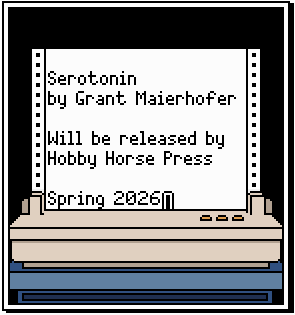
Serotonin: Writing and Depression
An excerpt from the forthcoming release from Hobby Horse Press
by Grant Maierhofer

Why, after such notable, such clear, such obvious improvement with the Effexor, back in Chicago, did I walk into our bathroom at the apartment, two or three weeks into the semester starting, and flush the bright pills down the bright white toilet? To say that I did this in the name of “authenticity” is incorrect, or only addresses aspects of what motivated me, rather than anything complete. Did I want to die? Did I want to return to my mental state before taking Effexor? These, too, seem to point towards the feeling without wholly touching it.
In retrospect, it was a move of desperation, and one about which I now feel deep regret. I wasn’t bored, I didn’t feel numb, I didn’t want to die in any direct sense—though I was certainly still ambiently suicidal, and would be for years to come—but rather I felt a kind of pathetic screaming in my head, almost a nausea, at my existence, at the predicament I was in, and an inability, finally, to follow through on this promise I seemed to have made to myself in pursuing the writing program in Chicago. I was theoretically completely immersed in writing, I thought about it almost every second of every single day, and read new things constantly, and watched new films constantly, and sometimes remained in movie theaters for two or three screenings just because it seemed to so perfectly agree with what I thought of as a desirable life. What’s more, I seemed to be able to recognize a way in which I was now energized by the medication, by Effexor, in my pursuit, but within me this quiet, pathetic yipping scream thing had been growing, which is sometimes thought of in recovery as the “addict voice,” though in this situation it might better be called the “depressive” one, a kind of clinging, a kind of sound argument that made me, again, feel physically troubled by the medication, nauseated and almost floating up outside of my present like will sometimes happen in dreams, where I’ll float just above the ground, doing otherwise normal things, and there’s no way for me to get down. This is, I guess, the self-sabotage impulse, which somehow in my brain can grip on aspects of my situation and adjust my logic, throughout my days, so that these arguments seem sound, even necessary, even inevitable.
I didn’t think in terms of my work, or my ability to produce work, when I flushed the medicine, but rather felt myself attempting to grab onto a very rawness of life, a desperate living, a breathing thing, an honesty—if I can call it that—with my physical relationship to my world, my room, my life. It’s so fucking stupid. I’ve had moments when it did seem inextricable from the work, as when I was listening to certain musicians, or artists, or writers, having already thought perhaps I’d stop, and I hear something either directly critical of antidepressant medication, or even vaguely so, from someone not even discussing the notion of depression, or mental illness, and I’d let that be the catalyst to quitting completely. But it was more as though I were shedding a skin, removing a divider between myself and my existence to not have so clouded a relationship with experience. This was my perception at the time, that in walking into the wood-floored bathroom, and dumping the bright orange pills into the toilet, I’d be arriving at a cleanness, and this proved sufficiently motivating.
What, since then, I’ve had to realize, is that the shawl of my depression acts as a more effective cloud over my experience than any amount of medicine, or illness, or lovestruckness might otherwise do. In fact, after the weeks of sleepiness, Effexor seemed to bring about just such a rawness, an ability to look with excitement at the marrow of life, but my mind seemed ready to turn this into a sort of trick, a sort of sleight of hand, creating an ultimate questioning of the logic of my present state, and a reversion to what I was actually doing compared with what my brain perceived. This is, again, a reason that I’ve come to so value my experience as a father, and a husband, because when I’m alone these thoughts will go unchecked, and more importantly untested, and I’ll find myself at the end of a long progression towards a very bad decision or idea or perception that, oddly, feels very good, very right, very clean.
I can see now, too, that by the end of my first year in Chicago, my OCD symptoms had grown so severe that something significant would need to happen, some shift, if I were ever going to move on. It began perhaps simply, wherein I’d read a new word in a book—I think the first might’ve been in Kenneth Clark’s The Nude, which I really enjoyed reading on the long train rides to class—I know, for instance, that “iridescent” was one, and instead of looking it up, maybe using it quickly in a sentence or two, and moving on, I would hold with desperation onto that word, and its definition, and go through my days repeating these things again and again. A sycophant was a “self-seeking, servile flatterer,” I’d recite, followed by seven or eight words and their definitions that, thankfully, I’ve now mostly forgotten. This became so derailing that I actually stopped going to classes, and spent a great deal of time walking around, finding strange men or women to talk to on the internet about sex, et cetera, until at one point I completely broke down to a friend and tried to get myself back to something tenable, but inevitably failed. The hyperawareness, the “rawness” that I’d apparently so desired when I’d flushed the pills, had come violently into my life, and I seemed to operate in an almost manic state, unaware of where my thinking ended and the world and its terrifying sprawl and energy began. I do know, having just referred to it, that there were ways in which I tried to write of these things before, in Postures, and elsewhere. I know that I repeat myself, that this is something I struggle with in writing, but I seem to need to do so here. I can’t easily express why.
I can, of course, understand the perspective of someone who feels as though their work will suffer if they take an antidepressant, but it hasn’t been my experience that this is the case at all. I think there’s a notion that suffering, like any negative experience, carries more weight in the life of the artist than joy, contentment, or positive experience, but I’ve come to realize that, especially without some sort of tangential outlet—in most cases, for most writers and artists, this seems to involve drinking or other escapes—negativity can beget a circumstance wherein you question, as constantly as you consider suicide, whether anything at all might be worth it, and if that’s the mindset that you’ve grown to romanticize, it can become very easy to think it represents the purest iteration of the life before you, when in reality at your beginning there were—and this is true of anybody who sticks with an artform for any length of time—positive experiences with works of art, even if those positive experiences were only with works of art whose entire outlook was depressive, which for most of us is absolutely the case. I’ve come to realize, too, that this is likely the case for most of us, not merely depressives, and not merely artists or writers. The negative experience is terribly easy to hold onto, it seems to happen naturally. The positive experience requires effort to hold. The writer, or the artist, I guess, has lucked out at various points in their existence to experience the naturalness with which we hold to negative things when experiencing writing, or art, either that which we’re producing, or that of other writers, artists, whoever; and when I’ve been seriously depressed, these experiences prove almost impossible to cling to—I’m constantly interrogating them, belittling them, questioning them—and doubts about the whole enterprise, and whether I’ve ever wanted enough to write, if my motives are pure, etc. etc. etc., flow as easily through me as the thoughts of suicide.
When I read about John Fante walking miserably through LA, an apparition, stalking a woman and eating a cigarette she touched, though he might’ve been transmitting or rendering a negative experience, my reaction to it, my identification with it, was nevertheless absolutely positive, deeply so—I had found my brother. The same is true when I watch the mumbly bodies gesture apathetically in Anne Imhof’s performance works. The work itself might exude a pure depression, a pure negativity, but both the expression of it and my intake of it, if I’m really drawing from the well, is positive.
John Fante, in Ask the Dust: “One night a woman too beautiful for this world came along on wings of perfume, and I could not bear it, and who she was I never knew, a woman in a red fox and a pert little hat, and Bandini trailing after her because she was better than dreams, watching her enter Bernstein’s Fish Grotto, watching her in a trance through a window swimming with frogs and trout, watching her as she ate alone; and when she was through, do you know what I did, lady? So don’t you cry, because you haven’t heard anything yet, because I’m awful, lady, and my heart is full of black ink; me, Arturo Bandini, I walked right into Bernstein’s Fish Grotto and I sat upon the very chair that she sat upon, and I shuddered with joy, and I fingered the napkin she had used, and there was a cigarette butt with a stain of lipstick upon it, and do you know what I did, lady? You with your funny little troubles, I ate the cigarette butt, chewed it up, tobacco and paper and all, swallowed it, and I thought it tasted fine, because she was so beautiful, and there was a spoon beside the plate, and I put it in my pocket, and every once in a while I’d take the spoon out of my pocket and taste it, because she was so beautiful.”
I thought of this scene and of Fante almost daily when I was living in Chicago, one of few figures that cut through the stuff in my brain—I’d see heads-up pennies and swallow them while recounting words and their definitions; once I picked up a dead bird and carried it in my pocket, enacted weird rituals around urine; these were things that might rightly make me feel freakish—yet more unmoored from the living, outside the world and all the worse for it—but because Fante had captured it so sharply—Ask the Dust is rather a crystalline book, especially when compared with those he wrote before it, which sometimes ambled round and round their more incisive bits—I could read it, or even just think of it, and feel a peace in my unpleasant state.
Teaching has forced me to come to grips with this. When I stand in front of twenty to twenty-five young people, and I’m anxious, sad, frustrated that my books aren’t doing as well as I’d hoped, and I’m frustrated at more and more rejection, if I transmit this to them I can assure you the class will die, because I’ve done it. It doesn’t become some great tirade against the status quo—it’s just sad. So I have to find works that I can unequivocally endorse, get energized about, defend, share, and the reality that I had to do this when I was simultaneously fantasizing about the ways in which I needed to die only hardened its truth far more. This might, in a way, connect back to the notion of athletics as a support system for my experience of depression. Again, I never grew up interested in these things, but I came pretty quickly to love hockey this past year; love playing it, love watching it, love thinking about it, love everything involved. It tricked me, then, into loving these other things which supported it, much in the way I’ve had to trick myself into finding works which I can be wholly positive about with a room full of strangers, most of whom are likely as anxious and depressed as I am, or have been at any given time. What’s more, at least half of them will feel at best indifferent to what work I put before them, and more than half of the classes will reliably ignore pretty much everything anyway, so I’ve got to be certain myself and the students who read are reading things we can get something out of, depressed or not.
Through some mistaken trick of wiring in my head, a door was opened when I was very young, and into that door was flung every negative interpretation and every negative or positive actuality my head could find, and these things compounded, and compounded, while the alternative—an airy brightness, a smiling pleasantry—received minimal, scant attention. I don’t think I’m particularly unique in this respect. In fact, as I look around, I notice it affecting every single aspect of modern life. Catastrophizing, apocalypticism, a rampant search for the worst components of all living. Actively calling most aspects of modern life the worst components of all living. These things are not difficult to uncover. Perhaps, perhaps one might argue their necessity, that our being informed is what—I’m finding myself being given over to this vague tone I enter into when I’m running out of things I seem to actually want to say in a project such as this, so although I don’t know where this will continue to tomorrow I’m going to force myself to stop.