 And within the queer spectrum I think that (the worst version of the future) is something that trans writers specifically are more comfortable with. In a lot of ways I think trans people experience the limits of people’s liberality, especially trans people of color. I think there is a safe space–kind of–that you can still occupy in the world as a queer person right now… but not if you’re a queer person who’s trans. And there is a huge spectrum of transness, from essentially still blending in with heteronormative society: either passing, or as a nonbinary person who doesn’t medically transition at all–to the other end of the spectrum: very visibly trans and unsafe in the public world. I think all people who fall within that spectrum know that the more they might try to become themselves the less safe the world is going to get for them. They feel the limits of “liberal spaces” in a way that other queer people might not. And I think that has a lot to do with how trans people are writing about the future.
Transition itself is kind of a form of horror. This undertaking to change your body, or even just to really reorient your idea of yourself in this world, in order to get closer to something that feels true, or that feels honest… opens you up to the warping of your desire (to feel free in your body) by others.
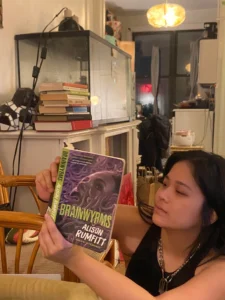 Mimi: It’s easy to doom scroll when you feel like there’s nothing else to do but consume the horror. It doesn’t abdicate you of responsibility, it makes you aware of your digital tether to it. We have all of this access to information and our phones become a theater for human suffering. We all have visibility into suffering on a planetary scale, and maybe it just feels easier to feel powerless and worthless than to…
Cole: find safety in any reasonable way… help or make anything better ?
Mimi: What’s freakier than being a void? To see the violence of everyday life, having it forced down your throat everyday, and then being able to remove yourself from that. Reject it even if it’s just by telling yourself that you’re worthless – inconsequential, released from the responsibility of living at all.
Cole: Yeah I was going to say relief. Because if you don’t find meaning in your life or if you’re really busy torturing yourself you can make the external violence feel like something you deserve. Or even something that you want to metabolize sexually. I think that there’s a really interesting use of fetish in her works. It gets at the darkness that’s in the external world of these characters; in order to reveal something about their internality. I think we fetishize what we see… and when everything we see is violence, it shows up in our desires too somehow.